The Thomases’ Grand Antipodean Adventure (4) – Arthur’s Pass (NZ)

Another Instalment

It’s been a while since I last posted on this topic, and since there is still a lot of the trip to go, I’d better add another day. The last chapter had us getting to Sydney airport for our morning flight to Christchurch NZ. Following our long-haul experience getting to Sydney, a 3.5hr “hop” over the Tasman Sea seemed pretty short. Again we flew with Qantas, this time on a Boeing 737. The flight into Christ Church on the South Island of New Zealand involves flying over the Southern Alps – the snow-topped mountain range which covers a large proportion of the western side of the South Island. More on them in later instalments.

(zoom out to see the full route).

The Hire Car

Our trusty  steed
Our trusty steed

After arrival in Christchurch, it was time to get the hire car. Rather than forking out with Avis or Hertz or anyone like that, I’d decided to go for a more “local” company, Kiwi Direct. The service and contact during the booking process was excellent. However, for those of us who are European and like a bit of formality and “in Ordnung” paperwork, that part did leave something to be desired. To pick up the car, we had to call a mobile number, and we were then picked up and driven to a layby where the handover happened – ie we signed the pink bit of the form, and the driver wrote down my credit card number. The hand-back instructions were given to us, he told us where the relevant buttons and switches were, got out, and left us to it! Having said that, they car worked fine, helped us cover the best part of 3,000km in 12 days, and coped admirably with the numerous excursions down gravel roads. All very excellent.

The Drive to Arthur’s Pass

Our destination for the night was the hamlet of Arthur’s Pass, a township of 54 people,

Heading to Arthur's Pass
Heading to Arthur’s Pass

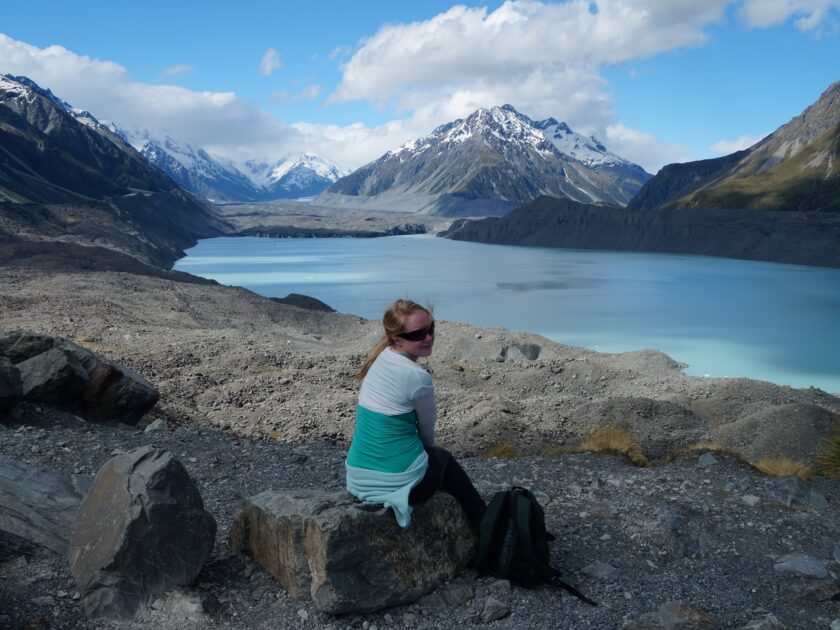
located about 750 feet above sea level in the mountains, and near the summit of the mountain pass of the same name. This was a 140km (90 mile) drive from the airport, the first half of which (in distance, but less in time) is across the Canterbury plain, characterised by long straight roads, and increasing views of the mountains. A lot of the route also follows the tracks of the TranzAlpine railway route from Christchurch to Greymouth. In the second half of the journey, the road winds its way through the mountains, passing soaring peaks, broad river valleys and forested hills. The road was also very quiet, making for excellent driving, although the three gears plus overdrive on our automatic transmission hire-car took some of the thrill out of the hillier sections. In many ways, it was very similar to driving through the European Alps, although the roads here are dramatically quieter.

Arthur’s Pass – the town and surroundings

View from Arthur's Pass
View from Arthur’s Pass

The township itself consists primarily of a large number of historical buildings (mainly single storey, and made from corrugated metal), a lovely hostel / motel (Arthur’s Chalet) where we were staying (the last two storey building for many miles), and the usual tourist info centre. There is also a railway station on the TranzAlpine, and a lot of walking tracks. We decided to use the advantage of the long evenings of daylight and have dinner before going for an evening stroll. We were advised by the Chalet that their main chef didn’t work that day of the week, and therefore to try the “Wobbly Kea”, which is the local hostelry. This was a great success – proper Alpine grub, washed down with lovely New Zealand wine (a sauv blanc for Mrs T, and a Riesling for me).

Dinner in the Wobbly Kea

A kea is a parrot, endemic to New Zealand, which is the world’s only alpine parrot. We didn’t spot any near Arthur’s Pass, but we did see them close up and in the wild later in the trip. After dinner we took a short walk up to the devil’s punchbowl, which is a rather dramatic waterfall. It was interesting for us to walk through the forest and see such different trees and plants from those we are used to back at home – the beech trees for example have such small leaves.

Devil's punchbowl

Next time

The next day involves stunning sunshine, a beautiful blue river, and a tiny settlement at the end of a road to nowhere.

Posted in Food, Nature, New Zealand, Photography, travel, wildlife, wine | Tagged , , , , , , , , , , | 1 Comment

Clergy Child's Lament

Reblogged from musingsofaclergychild:

I didn't choose it
You called my parents to it
You made a place for me
Where I thought there was none
Out of my comfort zone
And into Your calling

'Incarnational ministry', they call it
'Invasion of personal space', I respond
My house is not my own
My time is other people's
My life is a sermon illustration
I am to be an example to all…

Read more… 241 more words

I'm not a clergy-child, but this is well worth thinking about (especially for those who know clergy and their children)
Posted in General | Leave a comment

The Thomases’ Grand Antipodean Adventure (3) – Sydney

As promised last time around, next stop on the trip was Sydney. Flight time from Singapore was about 7.5 hours, which wasn’t really enough for a solid night’s sleep between Qantas squeezing another dinner into us and them waking us up for breakfast.

Arrival

We were to be staying with a friend in Manly (a nice suburb of Sydney), but it being a summer Sunday, he was engaged to play golf for most of the day, so we would meet him and drop off our kit. He’d promised us that the Syndey summer would not disappoint, and on arrival in the city (early in the morning), it certainly seemed hopeful. Wall-to-wall blue sky, and already 25 degrees by the time we got to Circular Quay (for the Manly ferry) at 8am.

The iconic Sydney shot

The iconic Sydney shot

Sadly, after meeting with Mr William Duncan Munro IV, on the Manly end of the ferry, and after he had promised us that it’d be short and t-shirt weather all day, things began to change. Which was a shame, since he’d left us for the next six hours, and he had the only keys to the flat which contained all our worldly possessions.It being a Sunday, we occupied ourselves for an hour or two at an excellent Church service at St Matthew’s, Manly, which is the only church I’ve been to which combines having an organ scholarship with having the sort of worship band which has guitar solos in the middle of songs! We received an excellent warm welcome, although it was rather odd singing advent music in the warmth.

St Matt's, Manly

St Matt’s, Manly

It was also unusual to see opening stained glass windows – back at home we do everything possible to minimise drafts in our churches!

After the traditional tea/coffee after church the weather had changed completely. Overcast, about 15 degrees, hints of rain, and we still had nearly 5 hours to survive! We decided to take a walk along the strand from Manly Beach (home of the “Manly Life Saving Club”) to Shelley beach. This is clearly a favourite summer Sunday walk for many families and dog-walkers, and it is very beautiful. There is plenty of good local wildlife to see too, from eastern water dragons to rainbow lorikeets. For a photo of the eastern water dragon, see my other site.

Rainbow Lorikeet

Rainbow Lorikeet

Surviving the cold!

The vigorous walk had kept us thermally ok for a while, but we were beginning to shiver, so we decided to use the transport passes to get back on the ferry (hoping that an enclosed space might be a bit warmer) to Sydney. The flat, calm seas had changed somewhat so the crossing was very bumpy, but quite good fun. Sydney is also a very challenging place to get an affordable snack – exchange rates are very bad for us Brits, and food is expensive, and we’d spent virtually all our Australian dollars on the transport tickets – note, always best to research how expensive places are before you arrive with too little currency! After sharing a sandwich and some very good chips with mayo(!) we ventured back onto the ferry, and back to Manly, with only another 45 minutes to shelter from the increasing storm to await keys and warmth!

A day out in Sydney

Monday was our full day in Sydney, and being a working day for Will, we were once again left to our own devices. The southerly had still not passed over, so it remained chilly and moist – we hadn’t expected to have to wrap up warm at this stage of the trip. Indoor activities were the order of the day, so we decided to go to Sydney’s excellent aquarium. This has excellent facilities and really good displays and interpretation of local wildlife, including the quintessentially antipodean mammal, the duck-billed platypus.

Sydney aquarium

Sydney aquarium

I would love to share my photo of the aquarium’s playpus, but, to be honest, it didn’t come out that well! There were also penguins, many sharks, an example of the really rather ridiculous dugong, and of course lots of beautiful tropical fishes. I let my belovèd loose with the camera, and she took some quite excellent photos.

After lunch (on the quayside near Darling harbour – special offer lunches for AU$10 each!), we decided to use our transport tickets to sight-see up one of the arms of the harbour (the Parramatta river), past the Olympic park to see what was up there – not a lot it turned out, although it was an interesting enough trip. Then it was back to Circular Quay, the Manly ferry again, and back for food and “tasty beverages” chez Munro.

Departure

The next morning, our flight required an early check-in (arrival at the airport by about 645). The ferry to town didn’t start up early enough, and we decided that since we had transport tickets, why pay AU$80 for a taxi. We were better than that!

Wobbly Kea

Wobbly Kea

We used the handy local bus route planner to plot a 2-bus+1-train journey to the airport which would get us there in time – there are buses all through the night, and they run on time and are mainly packed with people going to and from the gym it seems. Very successful, and much cheaper!

Next time… A Wobbly Kea in New Zealand.

Posted in Australia, Church, Friends, General, Nature, Photography, Singapore, travel, wildlife | Tagged , , , , , , , , , , , , , , , , , , | Leave a comment

The Thomases’ grand antipodean adventure (2) – Singapore

Singapore

Following on from my previous post, 12 and a half hours of flying later and we landed, about 1 degree north of the equator in the lovely city of Singapore. Changi airport is (for those used to London Heathrow) a bit of a revelation. Clean, efficient, and only the equivalent of £1 into the city centre on the shiny underground system. Singapore is very free of litter, and the underground trains are a real contrast to those in the UK – you are not even allowed to drink from a water bottle whilst on board, so they are not full of old newspapers and litter.

Clarke Quay Singapore

Clarke Quay Singapore

We had been slightly chicken, and booked a European hotel (the Novotel Clarke Quay). However, this turned out to be right near the centre of the thriving area of the same name – a beautiful spot for eating wonderful local food by the quayside. We had a fantastic meal (the picture on my previous post), and retired to the hotel to bed, having been given a free upgrade to a premium room.

A day of exploring

Hotel window view

Hotel window view

The next day dawned bright and sunny, and we were up early (about 6am); owing to the 8 hour time change it felt a bit like mid-afternoon. We had been told about the botanic gardens, and decided to head there before the day got too hot – coming straight from a British late autumn (or winter if you prefer) to 30 degree heat being a bit of a challenge for us (although a pleasant one). We had been warned that in December, Singapore is prone to being cloudy and rainy virtually all the time, so we were pleased to see the Sun during the morning!

Singapore is a very clean city, litter laws are strict, and even the dogs seem to have learnt from this. We saw many dog-walkers in the botanic gardens, and each time a dog needed to do its morning business, the owners managed to get pieces of news-paper down on the ground for the dog to defecate on, to avoid mess in the gardens. Lovely!

In the botanic gardens

In the botanic gardens

For us, the particularly interesting parts of the gardens were those in the original tropical rainforest, and the other tropical plants, since these are so different from home – even the grass in Singapore is different.

Returning from our walk in the gardens – it got too hot – we had agreed to meet a lovely friend for a guided tour. Our friend had moved to Singapore earlier in the year, and was clearly settling in well. After meeting near Marina bay, we had a walk around, and went to “The Shoppes at Marina Bay Sands(r)”. This is a large, air conditioned mall, complete with lots of designer shops, and also such things as an indoor canal with Venetian gondolas! The real highlight, in this city of much wonderful food, was lunch at Din Tai Fung, which consisted of wonderful dim sum, and beautiful fruit juices.

Marina Bay

Marina Bay area

Raffles

After lunch, is was time for a bit of a walk around, with the main aim of heading for the iconic Raffles hotel, home of the Singapore Sling (a cocktail), to sample one of the same. The odd thing about the Raffles bar is the tradition of customers discarding monkey-nut shells onto the floor, creating a distinctive crunch! It also creates a slight issue with pigeons flying into the bar area! In the end, we thought it a bit overrated for what it was, but the Singapore Sling was very very tasty (if a bit pricey).

Raffles

Raffles

By now, it was time to wander back to our hotel to pick up the luggage, to bid our friend adieu, and to head back to the airport for our onward flight. All in all, Singapore is a lovely place for a stop, and we would certainly like to go back there, possibly for longer than 24 hours, in the future.

Next stop

Next up – Sydney, and a thermal disappointment…

Manly Beach

Manly Beach

Posted in Food, Friends, General, Photography, Singapore, travel | Tagged , , , , , , , , , , | 1 Comment

The Thomases’ Grand Antipodean Adventure (1)

The first of many!

At the end of 2012, Mrs T and I set-off for a big trip – three and a half weeks visiting Australia and New Zealand. Our “excuse” for making the trip was that we wished to see two friends of ours in Melbourne who had got married during 2012, and whose wedding we had been unable to attend. An extension of the trip to NZ seemed like a sensible option, since we were going so far, and had always wanted to visit. A trip such as that has many highlights, and therefore I plan to blog about a segment of the trip, or an individual day, every so often for the forseeable future. My aim is to write about a new day or segment each week, but since this is the first post for 11 months, I suspect that that won’t quite happen. I’ll try to include some links to places we went or things we did, and also talk a bit about highlights of each location. I also hope to put a few of the more interesting photos up on Paul’s Photos.

The Trip

The map above shows the scope of the trip. We flew out to Sydney with a 24 hour stop-over in Singapore, followed by a couple of nights in Sydney, then onwards to Christchurch, NZ. We spent nearly two weeks driving around the South Island, before returning to Australia to spend Christmas in Melbourne. Return to the UK included a 24 hour stopover in Hong Kong.

Day One – Departure

All our flights were in economy class with Qantas, the National airline of Australia, originally named as the Queensland and Northern Territory Air Service. Our outbound flights to Sydney were on the Airbus A380, and we were very impressed with the level of service provided – the meals were excellent with a good choice of wine with them. Seats were comfortable and there was enough space (I’m fairly tall). The seats recline quite a long way, which does mean that once the person in front of you has commenced relaxation, you pretty much need to put your seat back straight away to avoid having them lying on your chest! Having been anxious about such long flights, we found that overall the experience was not too bad at all.

Departure was from London Heathrow, and Mrs T’s father had kindly volunteered to drop us off. The journey to the airport was uneventful, except for the final roundabout off the M4 (onto the infamous Heathrow spur). The traffic light phasing on the roundabout had led to the whole roundabout being full of vehicles, so it took nearly 40 minutes for the traffic to rotate the 270 degrees around the roundabout we needed to go! All the exits were clear, but the roundabout itself was completely blocked. All it would have taken was one policeman to stop people trying to enter the roundabout for one turn of the lights, and it would have sorted itself out. Heathrow Terminal Three wasn’t as awful as it could have been, and we enjoyed a surprisingly excellent meal at ‘British Restaurant and Bar “Rhubarb“‘ once through security. Decent food, not cripplingly expensive, and very good natured (Polish) waiting staff. An enjoyable experience to send us off.

Once on the flight, we discovered the ‘plane was quite empty, and after takeoff we moved to a block of three unoccupied seats so we could spread out somewhat. After another late dinner (take-off time was 2130), it was time to try to get some sleep, before arrival in Singapore, c. 13 hours (but nearer a full day in solar time) later. More about Singapore in the next instalment, but here is a “taster”.

Dinner in Singapore

Dinner in Singapore

Posted in Friends, travel | Tagged , , , , , , , | 1 Comment

A tour of some country houses

Last month, my belovèd and I tool a gentle tour of some of England, and called in at some lovely houses along the way. First was a trip to my homeland of Yorkshire to visit my parents, and to take in some of the National Trust’s best properties in the lovely March.

Beningbrough Hall

Beningbrough Hall

First on the list was Beningbrough Hall, just north of York. This house was built in the early 18th Century, and contains some excellent examples of local woodcarving, a skill for which York was justly famous in that period.

Beningbrough Daffodils

Beningbrough Daffodils

Photography is not permitted within the house unfortunately.

Additionally to the house, there is a lovely spring garden, which at this time of year is full of various breeds of daffodils, and is a real haven of peace and tranquility. The house itself looks over wide open grounds, and takes advantage of the flatness of the surrounding area to create grand vistas over the fields.

Day two of the trip consisted of an excursion to Whitby (where sadly the Abbey was not open), and a walk up to the delightful, if somewhat unusual church on the cliff top. This church has grown over the years in a rather random fashion, and contains some very unusual box pews (in which half the seats face away from the front) and quite a few areas where there is no possibility of seeing the altar.

Triple-deck pulpit

Triple-deck pulpit

It has two particular aspects which stood out to me – 1) the triple-deck pulpit, which still has attached ear-trumpets for the wife of a past vicar; and 2) the wonderful coal-burning stove which is still the only mechanism of heating the nave of the church.

On the return to York from Whitby, we passed through Nunnington Hall, a much smaller house than Beningbrough, but which was also particularly interesting – over time, the main axis of the house had changed by 90 degrees as extensions were built and rooms were reassigned. Some of the panelling and artefacts date back to the 16th century, although much of the house is in the condition that it was during ownership by the Fife family in the first half of the twentieth century.

Nunnington Hall Dining Room

Nunnington Hall Dining Room

Day three and our trip further North (Cumbria) commenced. Having stopped at the llama Karma café (see also my Scottish trip blogpost), for a quick bacon sandwich and cup of tea, it was to our next National Trust property, Acorn Bank mill and gardens. This house is not yet open for viewing, although the intention is to open it up soon, but there are lovely gardens, and a very interesting partially restored watermill. The gardens are particularly known for their collection of several hundred edible and medicinal herbs.

Aira Force

Aira Force

Next up on our journey was an old child-hood destination of Aira Force (National Trust car-park here!), and the classic short circular walk up the side of the falls, around to the next village, and back down the other side. We were blessed by a magical improvement in the weather in the Ullswater environs, and some excellent views down over that lake. A drive over an increasing misty Kirkstone Pass took us down the “Struggle” to Ambleside, and an excellent pub lunch, then over the hills towards Thirlmere and our Inn.

The King’s Head coaching inn (www.lakedistrictinns.co.uk), was our choice of location. Reasonable rates (c. £60 per room per night for B&B in winter), quirky rooms (ours had a four poster and Victoria bath), odd artefacts (the odd miniature suit of armour sort of thing), and a lovely location between the slopes of Helvellyn and the waters of Thirlmere made for a lovely two night stay. Only drawback is the noise from the road (single glazing), but that wasn’t too much of a problem in March (traffic pretty much stops after about 8pm!). There’s also a decent bar and excellent resident’s restaurant, with good quality food such as pheasant and other local produce. All very excellent.

Surprise view

Surprise view

Day Four and it was “walk day”, obviously facilitated by parking in another National Trust car park, Our route took us from the banks of Derwent water, up past the famous Ashness Bridge (postcard territory), beyond “surprise view” (pictured), and up to Watendlath, a very remote hamlet and tarn, which is allegedly Prince Charles’ favourite spot. A gentle walk over the watershed and down into Borrowdale took us to the half-way point of our expedition. The descent took us past the Bowder stone (a large rock deposited on what looks like a precarious knife-edge) by the action of glaciers in the last ice-age. No time to linger though, onwards toward Grange and the foot of Derwentwater, and finally back to the car. 8.5miles, 4hours, and generally a lovely day. The day still had enough time for us to venture to Castlerigg stone circle, but the combination of a bitter wind and our tiredness reduced that visit to long enough to take one photograph, before we went to find a nice dinner. For this we went to the location of my first legal drink, and provider of excellent, succulent sizzling steaks, the White Lion Inn, Patterdale. And then for an early night!

Hardknott Roman Fort

Hardknott Roman Fort

Day Five did not dawn as appealingly as the previous days, but nevermind! We set off in the car to another National Trust site – Hardknott Roman Fort. This is over the somewhat ridiculous Hardknott pass road, which is not in the best of condition, and is insanely steep – the road surface is buckled at the bottom of each of the steep sections, owing to years of abuse with the force of vehicles trying to get up, which has a rather negative effect on grip on these key sections of the road. The fort itself, known as Mediobogdum, is in a very remote, hilly location, which I’m sure has a great aspect on a sunny day, but on this most normal of Cumbrian days, in the gale and the drizzle, seemed like a very depressing place to have been posted, especially since most of those posted here allegedly came from the Dalmatian Coast of what is now Croatia. An afternoon snack at Coniston, and it was then time to head to our next beautiful country house destination.

Johnby Hall

Johnby Hall

Johnby Hall is not a National Trust property, but is the delightful home (and now B&B) of two of our friends and their family. With unique accommodation, and breakfast served in the Great Hall, it makes an excellent place for a stopover. Our room was in the “modern” 17th century wing of the house!

Hardwick Hall

Hardwick Hall

Our return home, via an excellent performance of Brahms’ Requiem in York Minster, given by York Music Society, was rounded off by an excellent tour of Hardwick Hall (you guessed it – National Trust), just off the M1 in Derbyshire. It is particularly noteworthy for the enormous collection of tapestries, which literally carpet the walls. It is also incredibly grand (as befits a home owned and used by the Countess of Shrewsbury). Well worth a visit and a tour, but the carpark was a total quagmire (despite the dry spell in March!).

Posted in General, Music, travel | Tagged , , , , , , , , , , , , , , , , | 4 Comments

Alsace Dessert Wine

Jos Straub Fis VT Gewurztraminer

Jos Straub Fis VT Gewurztraminer

Another day, another blog about wine. The picture shows the empty bottle from a recent evening’s wine-drinking with my fiancée. This time, we’d shared a small (50cl) bottle of one of Alsace’s more unusual wines, a gewurtztraminer vendanges tardives. This is a dessert-style wine, rather sweeter than a standard gewurtztraminer.

Vendanges tardives (late harvest) wines are a relatively (in the grand scheme of things) recent introduction to the Alsace, with the first wine with this description being bottled in 1976 after that long hot summer. The increased sugar levels which are part of the requirement for these wines give them their more syrupy character. Traditionally in the Alsace they would be drunk alongside foie gras or a tarte tatin.

The vintage in question is a 2005, which was one of the best Alsace vintages in recent years, with low yields, but sound grapes with ripe acidities.

This bottle was picked up during a trip to the Alsace in June/July 2010. This grower, Jos Straub et fils, is one of my personal favourites. He is tucked away in Blienschwiller on the Alsace wine-route, and doesn’t have anything in the way of a website. I’ve been visiting him every couple of years since about 2002. His small-scale business and the fact he doesn’t have an enormous sales operation mean that you get very personal service (a working knowledge of French/German really helps), and decent wines and very reasonable prices.

Gewurtztraminer wines are a particular speciality in Alsace, although they are also available in many other countries, particularly Germany. In German speaking countries, there is an umlaut on the “u”, although this is dropped on French bottles. The name means “spiced” traminer, and these wines are highly aromatic. Interestingly, the grape has a pink skin, but is a white-wine grape. The aromatic flavour of regular Gewurztraminer (as opposed to Vendanges tardives) means that they are one of the very few white wines suitable to accompany eastern cuisines.

Posted in General, travel, wine | Tagged , , , , | Leave a comment

Wine and Cheese

Wine and Cheese

Wine and Cheese

Time to actually blog again, and hopefully in a more interesting way! The other day I, my fiancée, and four very good friends decided to have a wine and cheese evening. It had been brewing for some time, as we had somewhat evolved into a dining (and singing) club over the previous few months. For a bit of variety we decided to replace dinner with canapés, and focus more on the wines.

I therefore, armed with a reasonable budget, went to the excellent and highly recommended Oxford Wine Company. We had decided to use this opportunity to learn a bit more about French red wine, and to also see if we could actually tell the difference between reasonably cheap wine (£20 per bottle), and more expensive wine (£45 per bottle). In the end, we purchase 3.5 bottles of wine, as follows:

1. Saint-Aubin 1er Cru ‘Le Charmois’, Château de Chassagne Montrachet (2006)

This wine is a Burgundy (a Pinot Noir from the Burgundy region), and was the lightest in colour and depth of the three red wines purchased. We all agreed that this wine was an excellent way to start the evening.

2. Château Jean Voisin, St. Émilion Grand Cru (2002)

This wine was a real treat. The tannins were first very noticeable, but after about 20 minutes of sitting in the glass and warming slightly, they dropped off revealing an exquisitely smooth wine, which went excellently with our varieties of cheese (see picture) and the end of the canapés. The primary grape here is merlot, with some cabernet sauvignon in the blend, typical of “Right Bank” Bordeaux appellations.

3. Château Dufort Vivens, 2ème Grand Cru Classé, Margaux

This wine was the most expensive of the three, and the oldest, being a 1995 vintage. This is a left-bank wine being a mixture of the same two grape varieties as the St émilion above, but this time with a higher proportion of cabernet sauvignon. This wine was really very very good, with a huge complexity of flavours throughout. The problem we found was that this actually made it harder to drink than the less complex St émilion. This is a wine I’d definitely want to try again, but this time with some tasting guidance and the ability to take some tasting notes. Wines of this style typically age very well (some only reach their best after several decades) and this was evident here.

4. 37.5cl Château Coutet, 1er Cru Classé, Barsac (1998)

A dessert wine to finish with, and only a mouthful each. This was a typical dessert wine with a thick syrupy colour and taste, but surprisingly refreshing. For a dessert wine, this is actually quite an early drinker (only 13 years old) and proved this by being very drinkable on the day!

The Cheeses

Just for the record, the cheeses consumed were a mature cheddar, some gruyère, manchego and some particularly excellent stilton.

I’d drink all the wines again, but the one I’ve bought another bottle of so far was wine no. 2, which will be excellent on its own, or with some Easter lamb!

Posted in Friends, Oxford, People, wine | Tagged , , , , , , , , , , , | Leave a comment

Student Funding – the injustice of the new plan

It’s been some time since I last posted, and even longer since I felt the need to vent my spleen, but this week’s revelations of the new student funding plans have provoked me!

Leaving aside the pre-election promises about not raising tuition fees (I can see the need for changes with the country’s finances in their current state), there are several issues at stake here.

The first is the ruling out of a graduate tax by members of both parties in the Coalition. Yet, when one run’s the figures of this new idea, one can see that in essence, for all but the richest or most highly paid graduates, that is what this proposal amounts to.

Even using the £6,000 value, and adding on £4,000 to cover living costs (a reasonably conservative estimate), the average graduate on a four year course (of which there are many), will have accrued £40,000 in debts.

At a “market interest rate” limited to RPI (notice that even though RPI has been replaced by CPI for most measures, it has been retained here since it is generally higher) + 3%, (say 5% once bank rates return to a more reasonable amount), then this amounts to £2,000 of interest in the first year. The government says it is being more generous by only taking payments once earnings reach over £21k, but this means that even someone earning £41,000 (the upper limit for the interest rate cap), will only be paying back £1,800. This will not even cover the interest, let alone repay the capital, and what graduate earns more than this in their first few years in work? Those earning a more average £25,000 will not even be making a small dent in their loan balance.

Once earning over £41k, the interest rate sets to the RPI + 3% measure, whatever the base-rate, ie about 6-8% based on recent trends. So even on a salary of £60,000 (an annual repayment of £3,510), will only just be paying back more than the interest. Repaying the capital within the 30 year cut-off period will thus be impossible for just about any students.

In fact, using a 6% interest rate, then for each of the thirty years, the graduate would need to earn over £53,000 in order to just repay the capital after the thirty years. Including wage inflation (eg at 2.5%), then a starting salary of £40,500 would be sufficient.

So, therefore, the likelihood is that virtually all graduates will end up paying this 9% of their earnings over £21,000 for the full maximum 30 year period. Which, to me, sounds more like a graduate tax than a repayment of a loan. This is made even more clear, by the implication that there will be sizeable penlties for those who wish to pay off the loans early, which also seems very unfair.

There is another reason why actually a real graduate tax is preferable to this system, especially since this system is a graduate tax in all but name; Being saddled with £40-50k of debt will make it all but impossible for any graduates to ever get a mortgage on a house. Having to pay more tax, however, would not cause this problem.

Finally, the apparent motive for this is to reduce government spending, but this method will not mean that the government actually saves any money – after all, they will still have to pay the money upfront to fund the courses. This scheme only saves the government more money in the long run. Not in the here and now when it is actually needed.

So, students are again bearing the brunt of the excesses of the previous generation, and will do so for a full thirty years in the form of increased effective tax rates, and inability to get a mortgage, while the government doesn’t actually save any upfront spending. Perhaps it’s time that students and parents wrote to their MPs, to Ministers and to the media to express their disatisfaction.

Posted in Finance, Politics | Tagged , , , , , | Leave a comment

Computer scam warning

It has come to my attention recently (and through some internet research) that there is currently a scam going on where someone will call your landline and inform you that your computer has been infected with a virus, and that you need to follow some steps in order to resolve this problem. This is a scam, and could lead to the caller being able to access your data, install programs, and read your confidential information. The scam can also involve the handing over of bank details, since they like to charge for “cleaning up” your machine.

If you receive one of these calls do not in any circumstances follow their instructions. Check that your antivirus is up to date (try AVG free from http://www.download.com for an excellent personal free antivirus suite).

Posted in General | Tagged , , , , , | Leave a comment